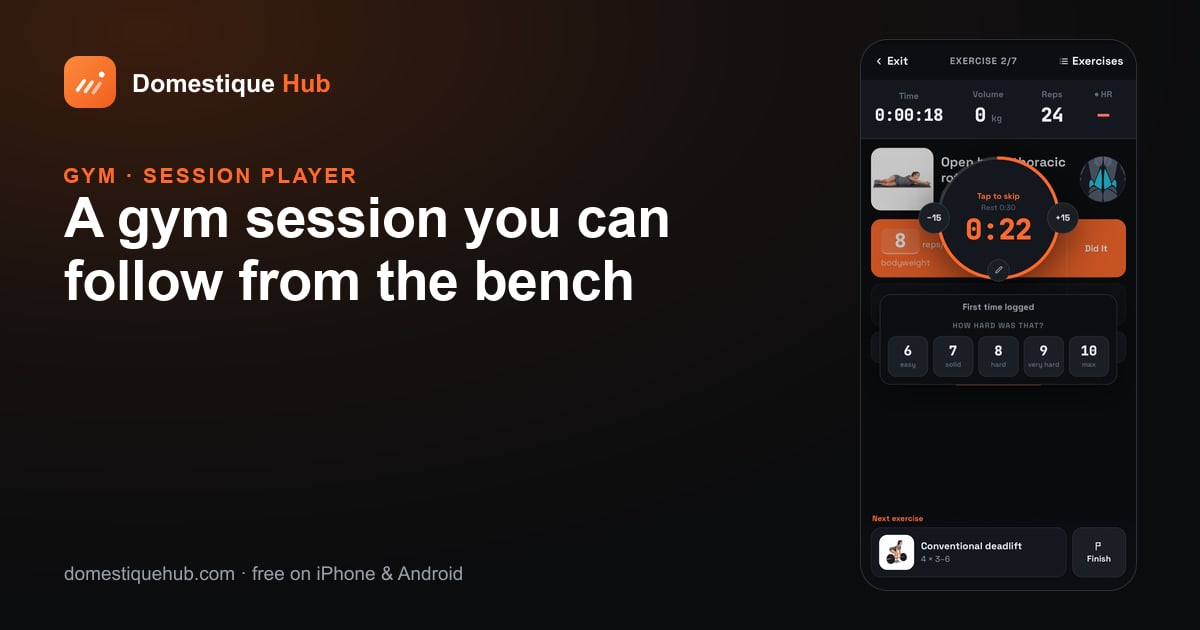
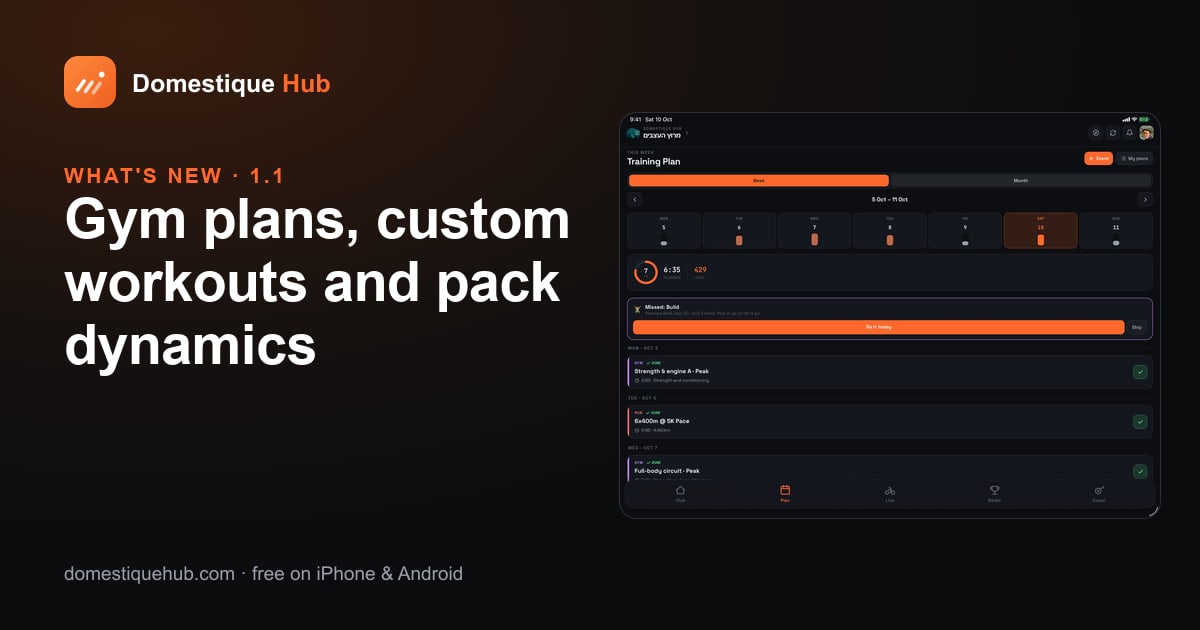
Strength training for runners, cyclists, swimmers and triathletes: gym plans built for your sport
Most gym plans are written for people who go to the gym. Ours are written for people who go to the gym so they can run, ride or swim better — which turns out to change almost everything about what goes in the week.
The sport decides which sessions are in the week
A gym plan for a runner is not a general plan done by a runner. What changes is which slots are in the week at all. When you pick a plan, the first thing it asks is what you train for:
- Runners get single-leg work, the calf and the hip. The two things that most often end a runner's season are the achilles and a hip that will not hold the pelvis level, and running trains neither.
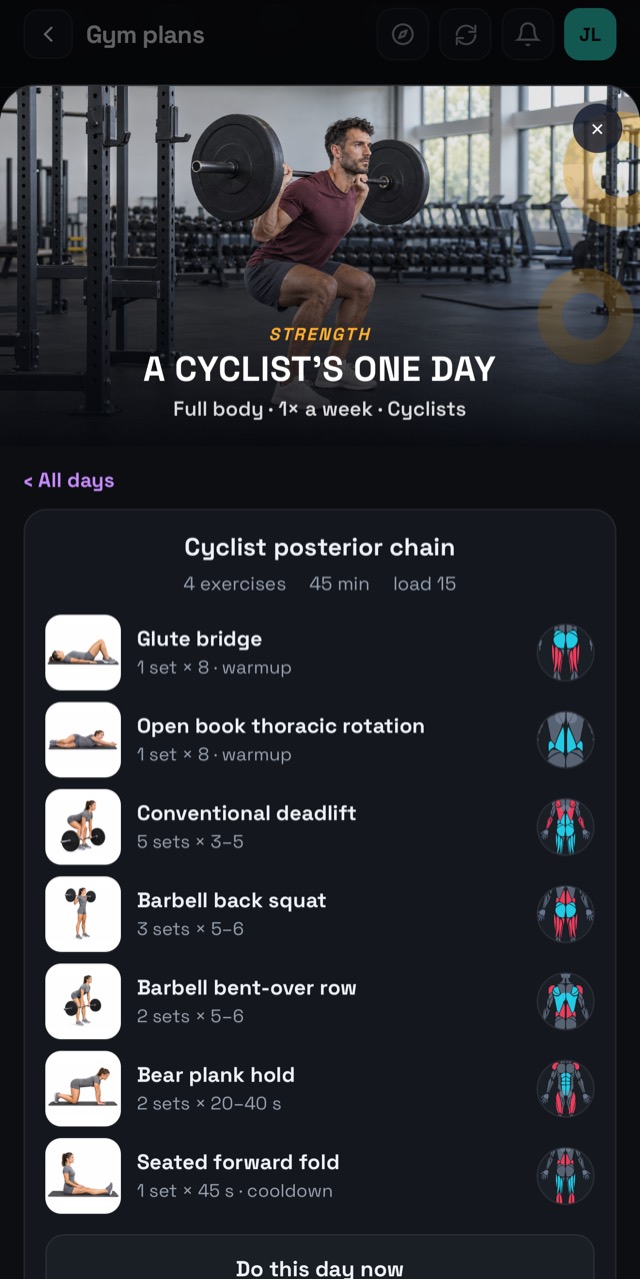
- Cyclists get the posterior chain and the upper back. Riding is a seated push: nothing about it trains a hinge or a row, and the position is held by a trunk that has to be strong enough to hold it for hours.
- Swimmers get pulling, and the rotator cuff by name. A shoulder that swims many hours a week needs the small muscles nobody else trains.
- Triathletes get the shortest week that covers the whole body, because they already have three sports and no time.
- Drivers get grip, trunk and upper back — holding a wheel against load and bracing for two hours.
Four-week blocks, not one week written out four times
A plan that repeats the same week is one week with a number beside it, and it leaves you to invent the progression. Every plan is a four-week block instead: three weeks build and the fourth backs off. A set more on the work, then the heavy end of every rep range, then less of everything so you arrive at the next block fresh.
The weight is never written into the plan. It comes from what you logged at the rack last time, which is the only number that knows how strong you are today. Sessions rotate through their family, so the hinge day is not always the one you do tired.
The plan bends to the room you are in
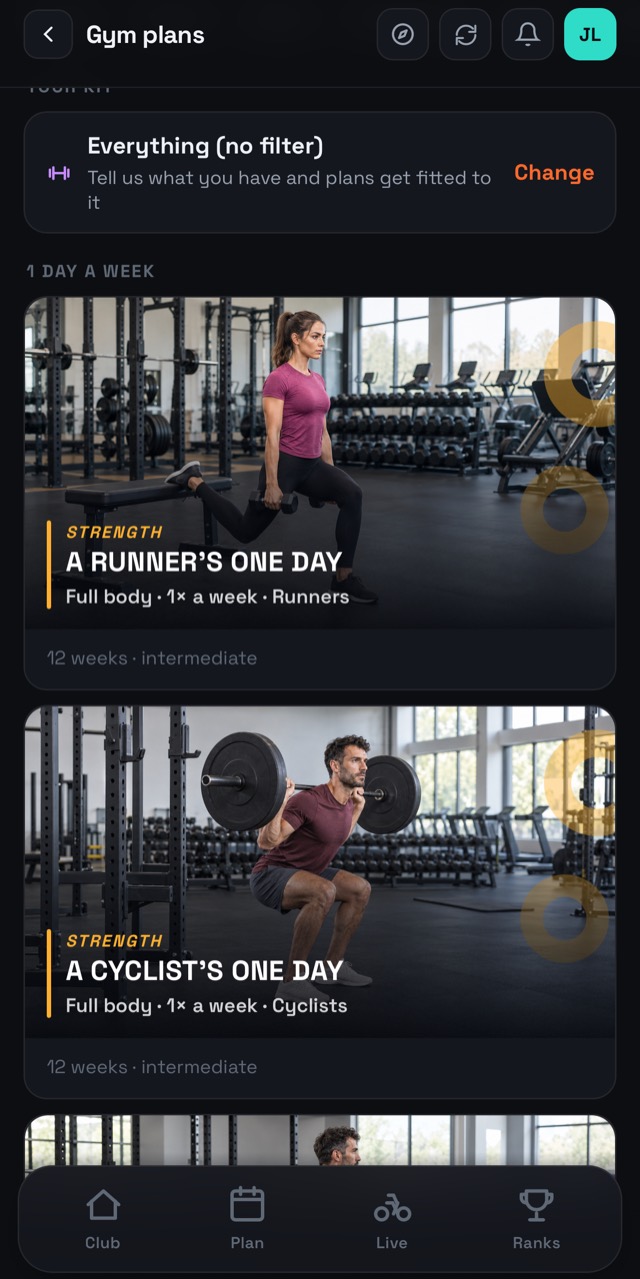
You tell the app what equipment you have by ticking it off a list with a photograph of each item — because "hack squat machine", "leg press" and "Smith machine" are three similar phrases for three very different objects. The list searches the words people actually use, so "kb", "curl bar" and "db rack" all find something.
Your kit does not hide plans. A plan written for a commercial gym is still offered to someone with a rack and a bench at home; the app rewrites it for that room and the card tells you how many exercises changed. A stand-in has to be the same exercise in every way that matters — the same movement pattern (a row is replaced by a row, never a press), the same muscles, the same difficulty and the same way of measuring it. The prescription never moves: five sets of three belong to the plan's goal, not to whichever exercise fills the slot.
Filter the shelf by sport, days a week, how long a session can be, how much gym you have done, the part of the body you want worked — and what is in your room.
A warm-up for your sport, too
Runners, cyclists and swimmers warm up differently, so the warm-up library does too. Runners get A- and B-skips, strides and hurdle walks; cyclists get spin-ups, a half-kneeling hip-flexor rock and a standing thoracic rotation that needs no floor; swimmers get external rotation at ninety degrees, prone swimmers and crossover arm swings. Ten of the warm-up and stretch routines can be followed as a single video — more on that in the session player post.
Getting started
- Open Plan and choose Gym plans.
- Tick the equipment you have, once. It is remembered.
- Filter by your sport and the days you can give it, and adopt a plan. It lands in your calendar next to your runs and rides.